Showing posts with label nick richards. Show all posts

Saturday, 4 February 2017

Let’s draw the Horniman Museum and Gardens - Saturday 25 March 2017

Horniman Museum
Nick Richards

Join us at the Horniman Museum in Forest Hill, South London, which has a wealth of subjects for sketching: the impressive and varied buildings, the museum’s eclectic collections, and all set in 16 acres of gardens.

Key meeting points for the day:
11am: meet inside the main building entrance, near the Navajo sandpainting.
1 pm: meet to share sketchbooks and experiences outside in front of the Conservatory (or if weather is bad, inside the main museum building at the lower ground floor level Gallery Square).
3.30 pm: finish in the same location outside the Conservatory to share sketchbooks and take group photos (inside in Gallery Square if weather is bad).
Horniman Museum
Nick Richards

The Horniman Museum was established by Frederick Horniman, a wealthy Victorian tea trader, traveller and collector. The main building, which was opened to the public in 1901, is an Arts and Crafts Movement building by architect Charles Harrison Townsend, who also designed the Whitechapel Gallery and the Bishopsgate Institute.
The Museum has free admission, although there is a charge for the aquarium (£4 for adults) and some temporary exhibitions. The museum is open from 10.30am to 5.30pm, although the café opens at 9.30 am.

The Walrus
Nick Richards
The Horniman offers lots to draw, both indoors and outside:
* As well as the historic main building with it’s modern extension, there is a modern eco building housing the library, and an ornate conservatory
* The museum’s collections include musical instruments from all over the world, a big natural history collection, and an aquarium
* There are 16 acres of gardens, including a formal sunken garden, a bandstand, unusual trees, and a sundial collection
* There are panoramic views over London from the gardens
* An animal walk (open 12.30 to 4pm) has alpacas, goats, sheep, guinea pigs, rabbits and chickens
* The Horniman hosts a farmers’ market on Saturday mornings, near the bandstand.
Tuba
Nick Richards
Practicalities

The museum has a café which can get quite crowded. There are other cafes and food shops in the area between the museum and Forest Hill station. It has a shop, a cloakroom and toilets.

Inside the museum there are the usual restrictions on using wet media such as watercolour. They don’t have stools to borrow, so you may want to bring one.

How to get there: the nearest station is Forest Hill, which is on the Overground, and on national rail lines from London Victoria and London Bridge. Further information is available on the Horniman website: http://www.horniman.ac.uk/

This day is run by Nick Richards with Jo Dungey


Share/Bookmark

Tuesday, 23 February 2016

Return to Silvertown

London's Urban Sketchers had their second visit to Silvertown, a 62-acre (25 hectare) development site in the East End that we have been invited to record as it gradually turns into the reality of the planners' vision. In the heart of London's old Royal Dockyard, and throbbing in the heyday of the British Empire, Silvertown began its decline in the 1960s, and is now a huge, barren wasteland next to City Airport that promises 3,000 new homes and 20,000 new jobs in the years to come.

Nick Richards, Silo D, Silvertown

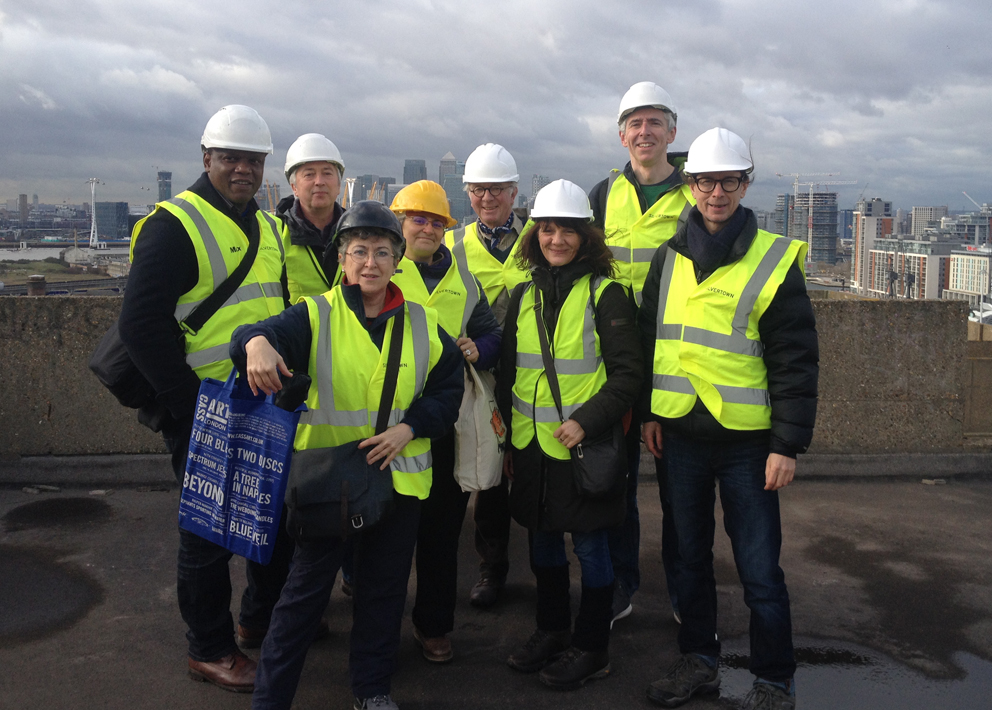
A few monumental buildings, such as Millennium Mills and Silo D, survive among the rubble, and will be restored. On our last visit, Millennium Mills was out of bounds because asbestos removal was underway. This time we were allowed inside, travelling up in the hoist, walking through its vast empty structure, and then out on to the 11th-floor roof overlooking the city.

Isabel Carmona, Millennium Mills (left) and Silo D (centre)

From the blustery rooftop, there were great view across towards the towers of the financial district, the Thames Barrier, the O2 Arena, City Airport, and the unspectacular conurbation of the East End stretching out to the horizon. In the wasteland below, the flashing lights of police cars and a burning vehicle were surrounded by a camera crew – one of many film units attracted to the gritty city feel of Silvertown.

Simon Privett, from the roof of Millennium Mills, looking west

Adebanji Alade, Millennium Dome from Millennium Mills

Simone Menken, looking west from the rooftop

James Hobbs, looking north from the roof of Millennium Mills

The giant mural on the side of Millennium Mills was created in 2012 by Shepard Fairey, the designer of the Barack Obama Hope poster.

Daniel Lloyd-Morgan, Attention Graffiti

 
Jo Dungey, Millennium Mills

The next 10 to 15 years will see this area change beyond recognition. There is a residential community close to the entrance to the site, but it is currently a quiet area – apart from the planes from the airport and construction traffic. Since our last visit in May last year (read about it here), there has been little outward change. The ground is cleared, and buildings rise in other sites around the periphery, but most of the action has still to arrive in Silvertown.


On the roof of Millennium Mills, from the left: Adebanji Alade, James Hobbs, Jo Dungey, Isabel Carmona, Simon Privett, Simone Menken, Nick Richards and Daniel Lloyd-Morgan.

The site is closed for visits now, but we're planning more in the future. Our thanks to the Silvertown Partnership for inviting us.


Share/Bookmark