Showing posts with label jo dungey. Show all posts

Saturday, 4 February 2017

Let’s draw the Horniman Museum and Gardens - Saturday 25 March 2017

Horniman Museum
Nick Richards

Join us at the Horniman Museum in Forest Hill, South London, which has a wealth of subjects for sketching: the impressive and varied buildings, the museum’s eclectic collections, and all set in 16 acres of gardens.

Key meeting points for the day:
11am: meet inside the main building entrance, near the Navajo sandpainting.
1 pm: meet to share sketchbooks and experiences outside in front of the Conservatory (or if weather is bad, inside the main museum building at the lower ground floor level Gallery Square).
3.30 pm: finish in the same location outside the Conservatory to share sketchbooks and take group photos (inside in Gallery Square if weather is bad).
Horniman Museum
Nick Richards

The Horniman Museum was established by Frederick Horniman, a wealthy Victorian tea trader, traveller and collector. The main building, which was opened to the public in 1901, is an Arts and Crafts Movement building by architect Charles Harrison Townsend, who also designed the Whitechapel Gallery and the Bishopsgate Institute.
The Museum has free admission, although there is a charge for the aquarium (£4 for adults) and some temporary exhibitions. The museum is open from 10.30am to 5.30pm, although the café opens at 9.30 am.

The Walrus
Nick Richards
The Horniman offers lots to draw, both indoors and outside:
* As well as the historic main building with it’s modern extension, there is a modern eco building housing the library, and an ornate conservatory
* The museum’s collections include musical instruments from all over the world, a big natural history collection, and an aquarium
* There are 16 acres of gardens, including a formal sunken garden, a bandstand, unusual trees, and a sundial collection
* There are panoramic views over London from the gardens
* An animal walk (open 12.30 to 4pm) has alpacas, goats, sheep, guinea pigs, rabbits and chickens
* The Horniman hosts a farmers’ market on Saturday mornings, near the bandstand.
Tuba
Nick Richards
Practicalities

The museum has a café which can get quite crowded. There are other cafes and food shops in the area between the museum and Forest Hill station. It has a shop, a cloakroom and toilets.

Inside the museum there are the usual restrictions on using wet media such as watercolour. They don’t have stools to borrow, so you may want to bring one.

How to get there: the nearest station is Forest Hill, which is on the Overground, and on national rail lines from London Victoria and London Bridge. Further information is available on the Horniman website: http://www.horniman.ac.uk/

This day is run by Nick Richards with Jo Dungey


Share/Bookmark

Tuesday, 31 January 2017

Spiders


When Tate Modern opened in 2000, the first artist to display work in the gallery’s vast Turbine Hall was Louise Bourgeois (1911-2010). Work on show included Maman (1999), the largest of her spider sculptures.


The spider has become one of Louise Bourgeois’ most well-known themes. Her parents ran a workshop for tapestry restoration. The title Maman alludes to the strength of her mother, with metaphors of spinning, weaving, nurture and protection.

Urban Sketchers London returned to Tate Modern for our sketchcrawl on Saturday 21 January 2017. Here are some of us in the Turbine Hall, looking at the sketches done that afternoon.

Photo: James Hobbs


Although the largest spider sculpture Tate owns, Maman, is not currently on display, the new Tate Switchhouse has an Artist’s Room devoted to Louise Bourgeois. This includes two other spider sculptures on display, which some of us drew:

Lis Watkins
'Spider' 

Jo Dungey
Spider 1 (1994)

Marie Desy-Field
Spider 1995


Share/Bookmark

Thursday, 10 November 2016

Let's draw Covent Garden Saturday 10th December 2016


Getting ready for the BAFTAs at the Royal Opera House by Lis Watkins


Key meeting points and times:

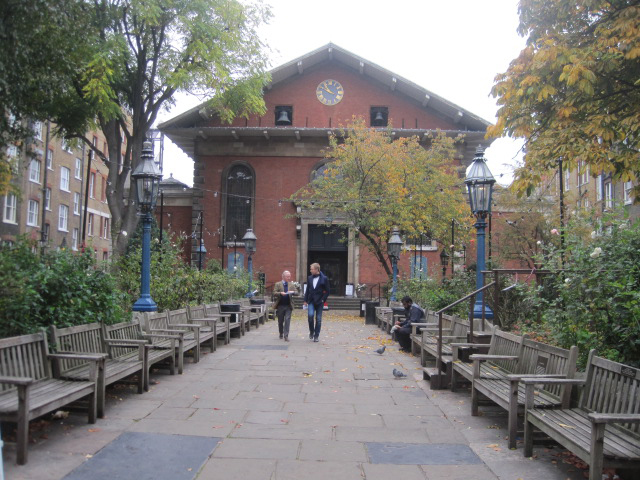
11 am     Meet in front of the church, St Paul’s, Covent Garden, on the market and piazza side (see photo above)

1pm        Meet in the churchyard by the door at the back of the same church (see photo below)


3.30 pm  Finish at Neal’s Yard (NB not the modern Thomas Neal shopping arcade).  See photo and directions below.

These locations have some shelter if the weather is wet.

Brace yourself to face the crowds, in December Urban Sketchers London visits Covent Garden.  But Covent Garden has more than shopping to offer.  Options for drawing include:


  • Covent Garden’s Victorian market buildings: the central market, the Jubilee Hall Market, and the Floral Hall


  • St Paul’s Church – the actors’ church – designed by Inigo Jones, with churchyard behind
  • Theatreland, including the Theatre Royal, Drury Lane, and Royal Opera House


  • The London Transport Museum (admission charge) 
  • Street entertainers
  • Shops and stalls, with seasonal decorations.


The area known as Covent Garden was originally arable land and orchards belonging to Westminster Abbey – the convent garden.  With the dissolution of the monasteries in the reign of Henry VIII (1540), the land passed to the Dukes of Bedford.  In 1630, the fourth Duke brought in architect Inigo Jones to develop the area.  Inigo Jones designed the church which is there now, St Paul’s, with a Tuscan-style portico, and laid out a piazza in the Italian style – unprecedented urban design for England at that time – with elegant houses around it.

For centuries this was a residential and commercial area of varying degrees of respectability, and associated with the arts.  The earliest theatres were the Theatre Royal, Drury Lane, and what is now the Royal Opera House on Bow Street.  The church is known as the actors’ church and has memorials to many famous names.  In the eighteenth century, writers such as Sheridan, Dryden and Aphra Behn, met in the area’s coffee shops, and the artist J M W Turner grew up on Maiden Lane where his father ran a barber’s shop.

Since the seventeenth century, the piazza was also used for fruit and vegetable markets, and to bring some order to this, in 1833 the covered central market building was designed.  This continued as London’s main wholesale fruit and vegetable market until 1974, when it moved south of the river to Nine Elms.  After a campaign against demolition, the market was re-opened to house the kind of shops and stalls we see today.  There are some old photographs displayed on walls inside the market building.

Places to draw which may be slightly quieter include the churchyard behind the church which has plenty of seats, the church interior, and the old streets and courtyards further away from the main piazza.  There are plenty of arcades and market buildings if the weather is wet, as long as you are dressed warmly.


There are plenty of cafes and bars, and public toilets near the church.  We will start the day in front of the church, and end the day at Neal’s Yard.  To get to Neal’s Yard, with Covent Garden tube station behind you, walk up Neal Street, turn left into Short’s Gardens and then right down a path next to the Benefits shop, signed above with a barrel.


This day is run by Jo Dungey


Share/Bookmark

Thursday, 8 September 2016

Let's draw Smithfield: Saturday 15 October 2016


Smithfield – “the smooth field” – was the site of a livestock market dating from the medieval era, and of the annual Cloth Fair held around St Bartholomew’s Day.  It is outside the area of the City of London destroyed by the Great Fire of London of 1666, so has some very old buildings, including the oldest church in London.

The nearest Underground station is Barbican.  From Aldersgate, walk along Long Lane and you will soon see Smithfield Market.  We will meet at West Smithfield garden, a small circular city park in front of the market building.


Summary of the day:
  •          Meet at 11 am at West Smithfield garden in front of Smithfield Market
  •          Meet at 1 pm in the same place
  •          Meet at 3.30 pm either at the West Smithfield garden if dry or the Rising Sun pub on Cloth Fair if wet


Smithfield is an area of varied history, and rapid change, and offers a great mix of subjects to draw:

Smithfield Market is a large Victorian building (see top image) completed in 1867 (architect Horace Jones), a wholesale meat market (trading Monday to Friday).  At the southwest end are disused buildings, formerly a general market, which have been acquired for redevelopment as a new location for the Museum of London.  The provisional opening date for this is 2021.


St Bartholomew’s Hospital has stood on this site since 1123, and some of the existing buildings date from the eighteenth century.  The hospital complex includes St Bartholomew the Less church (unlikely to be open), and a courtyard with a fountain and plenty of seats.  The hospital’s Henry Vlll Gate is on West Smithfield.


Memorials: Smithfield was for centuries a site of execution.  Memorials alongside the hospital include one to William Wallace, Scottish leader executed in 1305


St Bartholomew the Great church: the oldest church in London, interesting interior and exterior, admission charge, open 10.30 am to 4 pm


The Old Bailey, the Central Criminal Court, down Giltspur Street


Postman’s Park and St Botolph Aldersgate, down Little Britain.  The park includes G. F. Watts’ Memorial to Heroic Self-Sacrifice

The Museum of London on the junction of Aldersgate and London Wall, free admission, open 10 am to 6 pm

I have listed quite a few options as the impact of building work in the area is unpredictable.

Wet weather options include the interior of St Bartholomew the Great, interiors of pubs and cafes, and the Museum of London

Facilities: Old pubs are characteristic of the area, although not all open on Saturday.  The Rising Sun, 38 Cloth Fair, the Old Red Cow, 71 Long Lane, the Fox and Anchor, 115 Charterhouse, should be open, also Carluccio café on West Smithfield and cafes near the tube station and the Museum of London. 

This day is organised by Jo Dungey.


Share/Bookmark

Tuesday, 23 August 2016

Greenwich


Despite the very unpromising weather early in the day, the skies cleared on Saturday for the August sketchcrawl in Greenwich, with a great turnout, a mix of familiar faces along with some international visitors from Australia, Barcelona and New Zealand.  
Below are just few snaps of sketchbook drawings from the day.  Apologies for the names that aren't credited, if you recognise your drawing, please let us know in the comment box and we'll remedy it as soon as possible.


Sue 

Paul

The Cutty Sark proved a popular subject throughout the day.


Daniel

Great views across the Thames, from the shore or up high near the Observatory.

Alice


If you are on Flickr, you can apply to join the London Urban Sketchers Flickr page or those on Facebook can join the London Urban Sketchers Facebook page.  If you are on Twitter or Instagram, use the hashtag #urbansketchers for your work to get seen and shared by others.

London Urban Sketchers Flickr page https://www.flickr.com/groups/usklondon-grouppool/

London Urban Sketchers Facebook page 
https://www.facebook.com/groups/318585898339169/

Thank you to everybody who came along and hope to see you all at the September outing to Little Venice!


Share/Bookmark

Saturday, 23 July 2016

Trafalgar Square sketchcrawl


A lovely sunny day for the Trafalgar Square Sketchcrawl today!


The Square itself provided lots of inspiration for sketchers - this watercolour was by Sheila.


There was a busking event taking place and Jason sketched a number of the musicians.


The youngest artist on the sketchcrawl today was Trini, who at only 9 years old produced some wonderful drawings including this one of Nelson's Column.


At lunchtime, we met up under the Duke of York Column, with the steps becoming a sort of altar for the sketches of the day so far.


The lunchtime group shot with some familiar faces and lots of international visitors on their way to the Manchester symposium.


Watercolour by Michael.


Finding a little shade on a very hot day for London.


At the end of the day outside St.Martin-in-the-Fields.

Thanks to everyone for coming along, we hope you enjoyed it.  
Don't forget that there is another sketchcrawl tomorrow (Sunday 24th July), details here -  

Next month's sketchcrawl is in Greenwich on Saturday 20th August., meeting up at 11.00 am under the bows of the Cutty Sark.
Full details can be found on the blog on this link - 


Share/Bookmark

Tuesday, 23 February 2016

Return to Silvertown

London's Urban Sketchers had their second visit to Silvertown, a 62-acre (25 hectare) development site in the East End that we have been invited to record as it gradually turns into the reality of the planners' vision. In the heart of London's old Royal Dockyard, and throbbing in the heyday of the British Empire, Silvertown began its decline in the 1960s, and is now a huge, barren wasteland next to City Airport that promises 3,000 new homes and 20,000 new jobs in the years to come.

Nick Richards, Silo D, Silvertown

A few monumental buildings, such as Millennium Mills and Silo D, survive among the rubble, and will be restored. On our last visit, Millennium Mills was out of bounds because asbestos removal was underway. This time we were allowed inside, travelling up in the hoist, walking through its vast empty structure, and then out on to the 11th-floor roof overlooking the city.

Isabel Carmona, Millennium Mills (left) and Silo D (centre)

From the blustery rooftop, there were great view across towards the towers of the financial district, the Thames Barrier, the O2 Arena, City Airport, and the unspectacular conurbation of the East End stretching out to the horizon. In the wasteland below, the flashing lights of police cars and a burning vehicle were surrounded by a camera crew – one of many film units attracted to the gritty city feel of Silvertown.

Simon Privett, from the roof of Millennium Mills, looking west

Adebanji Alade, Millennium Dome from Millennium Mills

Simone Menken, looking west from the rooftop

James Hobbs, looking north from the roof of Millennium Mills

The giant mural on the side of Millennium Mills was created in 2012 by Shepard Fairey, the designer of the Barack Obama Hope poster.

Daniel Lloyd-Morgan, Attention Graffiti

 
Jo Dungey, Millennium Mills

The next 10 to 15 years will see this area change beyond recognition. There is a residential community close to the entrance to the site, but it is currently a quiet area – apart from the planes from the airport and construction traffic. Since our last visit in May last year (read about it here), there has been little outward change. The ground is cleared, and buildings rise in other sites around the periphery, but most of the action has still to arrive in Silvertown.


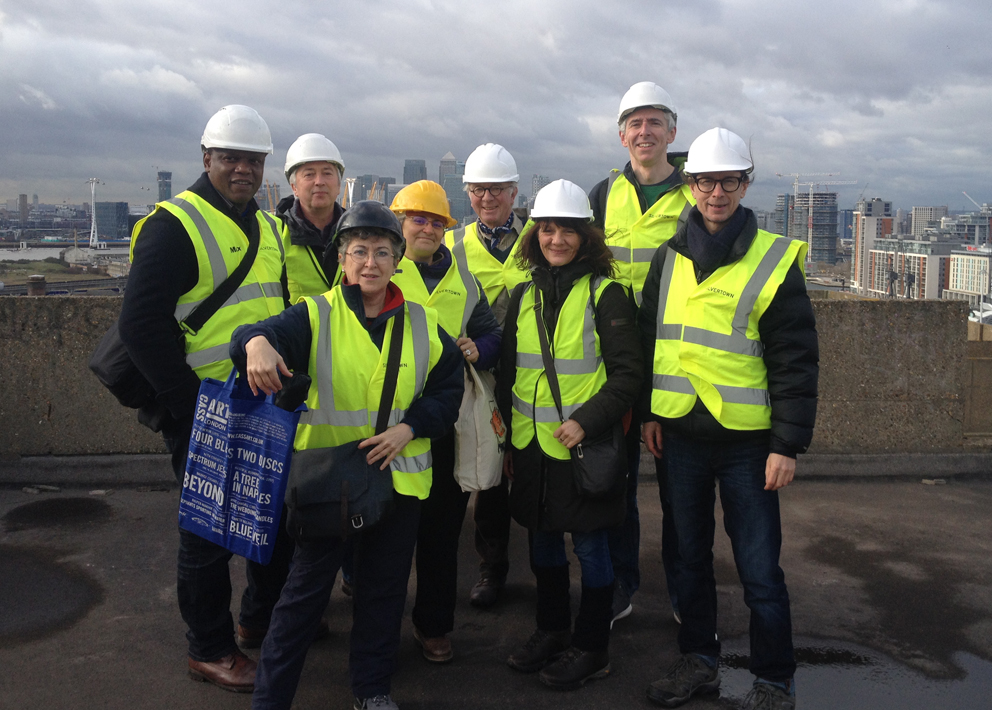
On the roof of Millennium Mills, from the left: Adebanji Alade, James Hobbs, Jo Dungey, Isabel Carmona, Simon Privett, Simone Menken, Nick Richards and Daniel Lloyd-Morgan.

The site is closed for visits now, but we're planning more in the future. Our thanks to the Silvertown Partnership for inviting us.


Share/Bookmark